You can get there from here

Two of Dad’s early sculptures, with candles from Tony to remember them during this season. Mom died three years ago, a few days after Thanksgiving. Dad died two years ago today.


Sometimes I drive like my father: smooth yet efficient, elegant yet slightly aggressive, ready to take advantage of better pathways. Dad drove with confidence, secure in his reflexes, his command of the vehicle, and his geographic acuity.  

Sometimes I drive like my mother, with a frenetic energy, on high alert for danger, scattered.  Mom was the best conversationalist in the car if you felt like talking. She laughed at the right moments and gave an indignant “Oh for goodness sake!” as you told an outrageous story. 

While driving to a meeting or social event Dad’s mind was likely thinking ahead to what he wanted to say upon arrival. His comedic timing was so good and his stories, whether short or long-form, were polished in a way that you knew there was planning involved. 

Dad was expert at giving directions, a human GPS for anyone in need. I remember sitting in our cozy kitchen on Allentown Road, preparing to receive his instructions before driving somewhere unfamiliar. The overture to Dad’s directions was always “Well, you can’t get there from here.” He delivered the line in such an earnest tone that it never stopped being funny to me. 

Next came the drawing of maps on scraps of paper. Dad was in his element as he held forth. There were musings about the nuances of different routes and more drawing of the options. You could do this, or you could do that, or here is another possibility. “It’s up to you” he would say, though when pressed he would tell you what he would likely do. 

During a college break, I sat at the kitchen table with Mom and Dad as he drew a map for my upcoming trip to western Pennsylvania. I was going to my friend’s wedding over the New Year’s holiday.  I was to play piano or lead hymns or something like that at the wedding, and I couldn’t wait to be there. But then a blizzard emerged in the forecast, along with gentle words from both parents to prepare me. “You might not be able to get there.” I was insistent that I had to get there and that I would be careful, I would be safe. Finally my friend called and said, “Bev, you can’t get here. It’s ok. We’re going ahead, with a small group of family present.” I recall my parents’ quiet relief, and then my own as we settled into the pleasure of more time together, secure and warm while the snow swirled outside.

When Mom drove me to my weekly piano lessons in Quakertown she put aside her natural instincts for chatter so that I could silently study my scores, drilling intricate passages on my lap that I didn’t practice at home. I can still feel her glancing at me briefly from the side as she drove, with a slightly concerned look, perhaps wondering if they as parents were doing enough to nurture this unexpected affinity I had for the piano. I was never ready for those lessons, and she knew I needed to focus. I worry I could be sullen back then, but I like to think we talked more after the lesson with all that anxious tension released.

Legend has it that one time Mom sat in the passenger’s seat as her sister Alice drove them to visit my grandma in Lancaster. While Alice drove, Mom held the toll ticket in her hand as they talked nonstop. When they arrived at the toll booth Mom looked down at her hands and realized that during their animated discourse she had torn the ticket into many little pieces. 

It’s possible I have the wrong sister in this story. Maybe she was with Emma, or it was all three of them. Perhaps Mom was driving and it was Alice or Emma who tore up the ticket. With these three sisters the story can work in multiple ways. 

If Helen Longenecker’s mode in the car was conversation, Dad was more likely to be quiet as he drove. He and I often rode together in silence. We learned to be ok together without noise. 

Dad liked to catch people off guard with off-beat statements or questions. He varied his repertoire to keep these unique Sam Lapp lines fresh and unexpected.  A favorite: “Are you a thinker or a stinker?” He himself was a thinker with an inner world that became less mysterious as he aged. “When did Dad become an oversharer?” my brothers and I sometimes wondered.

If my younger brother David or I ever got lost while driving, we felt no need to burden Dad with it. Why make him shake his head, perplexed about how anyone could do what we did? Once when returning to my parents’ home from an evening in Philadelphia, my spouse Dale and I somehow missed the turnpike exit to Lansdale. As we continued on to the next exit it took discipline to not let frustration about wasted miles and lost time lead to recrimination. I declared, “Dad does not need to know about this. It would drive him crazy. We are not telling him.”  And we never did. 

My older brother Tony, however, had an unwavering need to confess to Dad if he ever got lost or had another mishap while driving. He needed to find some sort of absolution through Dad’s incredulous reaction. 

One time in her 50s my Mom was driving home from her job in Harleysville and didn’t fully stop at a stop sign at a quiet intersection. She was quickly pulled over by a police officer, who gave her a warning and urged her to be more careful. The very next day Mom did the exact same thing on her way home from work, and the exact same police officer pulled her over. As she lowered her window and looked him over, she said, “Officer, we need to stop meeting like this.” 

These days I can’t think of this story without also seeing the white privilege part of it.  Mom surely knew she was getting a ticket this time (and she did), but she also felt safe making a sassy comment to a police officer. 

I remember us three children sitting in the back seat as we drove home from get-togethers with the Longeneckers in Lancaster or Middletown, PA. Dad was expertly driving, following his instincts, never getting lost. I can hear Mom happily talking, filled with satisfaction from being with her siblings and their families. I can hear Dad remarking on a fascinating nephew or remarkable niece. I don’t remember what Tony, who was constantly reading, was doing without any easy light. Maybe there was a flashlight, or arguments about using the car light. Nor do I remember how David spent that time. No doubt he wanted his older siblings to interact with him, and we likely were not obliging, to my regret now. 

On those late night drives I leaned my head against the door, softly improvising words and melodies into the window glass. I thought it was my private moment, but surely the rest of the family heard me. No one ever told me to stop, at least not that I can recall. I wonder what my parents thought of the creations they heard coming from the back seat. 

My brothers reminded me of a feature when Dad drove us home from the Longenecker farm in Middletown. Dad reliably sped over a notable bump on Fulling Mill Road with just the right timing to give his kids the perfect thrill. That bump is now smoothed over, another marker of change. 

In summer 2021 I drove with Dad and Tony from Goshen, Indiana to Lansdale, Pennsylvania. We were in Dad’s last car, a 2014 Buick LaCrosse, and he wanted me and Tony to do most of the driving. He regularly offered suggestions, especially about when we should shift lanes. His tone was gentle, but we knew his teacherly voice well. Tony and I fell into tacit agreement that when you have a wise guide, you may as well listen. I think if Dave had been with us on that drive he would have teased Dad more, telling him to stop being so damn directive. Dad would have enjoyed this and responded that it’s not his fault his kids don’t know how to drive right. There would be more banter, and lots of laughter. 

About three months before Dad died, we had a discussion about whether it was safe for him to continue driving. He told me and my brothers that we needed to keep in mind his superior driving skills, the fact that even though he was very sick, his reactions and instincts were still better than the average person on the road. Dad was so serious as he said this, but it could be hard to tell when he said things in that tone. Was he trying to get a reaction from us? We playfully noted his incredible ego when it came to his driving, but also validated his point. The mood stayed solemn and the matter unresolved, though Dad may have thought he won the argument. Even so, we managed to keep the car keys away from him going forward. The three of us later agreed that even though our strong Dad was now so frail and vulnerable, he was still likely to be a better driver than many at their full capacity. 

I am driving that same Buick these days. Sometimes I drive like Dad, competitive about shaving off seconds here and there through strategic efficiencies, and focused on where I am going next and what I will say when I get there. If Dale is in the passenger seat he is sometimes alarmed at my aggressiveness. Dale grew up on a farm in central Kansas, where driving was usually a break from hard work. Drives were to be relished and unrushed so there was adequate time to check out the neighbor’s fields and see what you could see as you moseyed by their homes. Dale typically doesn’t care about being early, or late. Whenever I pull the “Pittsburgh Left” at an intersection (It’s so efficient! It helps everyone be more timely!) Dale turns pale and notes that in Kansas, this would be seen as the height of rudeness. 

During a recent trip to Kansas I was at an intersection in downtown Newton, with an opportunity for the Pittsburgh left. I was alone, but thought of Dale, and resisted the impulse. Dad would have both understood the temptation and approved of my decision. “Remember who you are,” he liked to call out as we left the house as teenagers and young adults. “Remember where you are” is also good advice.

Sometimes I drive like Mom, intensely focused while at the same time my mind runs in multiple directions. Like my mother I can be a delight to be in conversation with while driving. One time I traveled with my cousin Marcia on yet another road trip from Indiana to Pennsylvania. Marcia is the daughter of Alice from the torn toll ticket story. We talked without ceasing and got lost at least once on a route that is almost entirely one interstate highway. At the end of the full day’s drive home, as Marcia pulled her car into my driveway, I said, “It can’t be over already – we need more time for the topics we didn’t cover!” 

I don’t know if I mostly drive like my mother or my father. I suppose I drive like my unique self, yet influenced in so many ways by each of them.

How I miss these gems, these giants in our lives. They helped us consider and accept that we may not always be able to get there from here. And yet they gave us confidence that most of the time, we can. 
Some Sabbatical Reflections

These words are adapted from a chapel reflection I gave at AMBS in February.

In 1951, Rabbi Abraham Joshua Heschel published a slim volume on the observance of the Sabbath. Heschel was a prominent rabbi and Jewish public intellectual, and was deeply involved in the civil rights movement, including participating in the march from Selma to Montgomery. His book on the Jewish Sabbath talks about sabbath as the gift of time. As Fannie Bialek reflects in the essay linked below, to Heschel sabbath is “a realm of time, distinct from the realm of space, where we live the other six days of the week. In the realm of space our aspirations are competitive: You and I can never occupy precisely the same space, so our projects in the realm of space are defined by jostling for possession, security and control. But time can be spent together — we can share time, fully, in a way we can never fully share space. That defines the aspirations of time differently: not to have, but to be; not to own, but to give; not to control, but to share; not to subdue, but to be in accord…” See Bialek’s full piece at https://humanities.wustl.edu/features/fannie-bialek-politics-time-lessons-sabbath-justice

My primary goals for sabbatical were to receive spiritual direction twice per month, to work on some musical projects, and to spend time sorting, reading and reflecting on a sizable collection of written material by my parents who each passed away in the last two years. I did all these things, and tried to remind myself that none of these projects would or should come to a place of completion. My spiritual director helped by introducing me to Rabbi Heschel’s view of sabbath. She described sabbatical as rooted seed, and that when we allow ourselves to rest, what is rooted in that rest can now flower. This idea of sabbath as the root of something allows us to think about what was started and what will continue rather than what we got done. 

As I pursued my three primary projects, I noticed three stages that I was moving through in both linear and circular ways: Emptying, Inviting, and Creating. 

About Emptying

I was quite tired as sabbatical began. It was a good tired, the kind you feel after working hard to make something happen and then getting the opportunity to rest after that something has happened. What I was resting from included a rush of activity as I prepared to be absent from AMBS for three months, which meant lots of meetings and preparation of documents and resources for colleagues who would be responsible for my usual work. 

I was also resting, in a sense, from five fairly intense years at AMBS and the unexpected losses of both of my parents 13 months apart. There were a lot of experiences that I wanted to reflect on. 

I also felt overwhelmed with details. My brain felt too full and cluttered. While I felt I could manage ok without a sabbatical, I also recognized that my brain needed some rest from details. One of the first books I read was Ten % Happier by Dan Harris, a book about meditation and mindfulness written by someone who was very skeptical about meditation. I have only just begun a meditation practice, but one way I’ve learned to think about mindfulness is that it is an emptying, creating space for the Spirit to speak and lead. We can practice this in many ways. We can close our eyes and slow down our breathing…and then focus our minds only on the sounds we hear in a quiet room. As we do this we may notice various thoughts getting in the way…the meeting or class we need to prepare for, a conflict we are worried about, wondering what we will eat for lunch. We do our best to put aside those thoughts and only notice the pace of our breathing and any sounds breaking through the silence of the room. If the thoughts break through again, we try not to judge ourselves. We try to simply notice that it happened and gently put them aside once more. 

One of the most profound mindfulness experiences I had on sabbatical was in mid-November. It took place during a live performance by the Philadelphia Orchestra in center city Philadelphia. Hearing a professional orchestra is a great joy for me, and I was excited about this concert. As I settled in to hear the opening numbers, I was reminded that these players are so good that it’s a real shame to let my mind wander while sitting in their presence. The second half of the program was the epic 1st symphony by Gustov Mahler and as it began I tried to focus only on the musical lines and trajectory, without any other thoughts breaking through. This seems obvious and basic but is incredibly hard for my wandering mind. I had some good stretches of focus, perhaps better than I’ve ever managed. It was so satisfying that I would have loved for the orchestra to announce that they were going to do the whole hour-long work again. 

I cannot fully convey how rewarding it is for me to listen or play music with this level of mindfulness, and how strange it is to realize that with three degrees in music, I’m still a beginner at it.

This type of listening, this type of mindfulness, requires an emptying. I began to listen to more music during the sabbatical, especially instrumental music without words. I pushed myself, reluctantly, to go on walks without a podcast or music to listen to, with the challenge of focusing as much as possible on what I saw or heard during my walk. With the help of a meditation app, I tried moments of centering stillness and breathing. These practices of mindfulness helped me engage in emptying and to get outside of my head.

About Inviting

The second stage I experienced was Inviting. I spent a lot of time reading my parents’ written materials. As I reflected with my spiritual director on what I was finding, it was hard to stop crying. At one point my director gently said, “I think your mother and father may be your guides through this season of your life.” This idea of still being mothered by the singular Helen Longenecker Lapp and fathered by the inimitable Sam Lapp, helped with the gift of boxes and boxes of their writing, was a profoundly comforting invitation. 

When he was 21 years old, my Dad moved to Honduras for two years where he worked as an agricultural and construction volunteer, as an alternative to military service. Dad wrote these words to his parents in January 1960. 

Dear Folks, 

I just moved my chair in from outside. It’s a beautiful evening outside and I simply had to go out to enjoy it. It’s one of those evenings when the people are outside instead of locked in their houses. There are a million stars visible to the eye and the moon is the size of one of the Honduran bananas. I didn’t feel one bit like coming inside cause the scenery and music of the out-of-doors is too wonderful to be missed. God’s creation in Tocoa is perfect like all over. The tall trees in the moonlight, the mountains and their peaks – overshadowed with dark fluffy clouds, and the thatched roof houses and their points jotting up all over is really a sight to see. There are frogs croaking and crickets cricketing and I can even hear the stars twinkling, all of which make up the best orchestry I ever heard. Fifty yards up our street are a couple of men singing to the accompaniment of a guitar…about the sun, moon and stars – that’s about all I can understand. Life is so different here. Really I feel like a million bucks and I like everything here more each day. I learn a little more Spanish each day and that makes it a little easier to learn a little more so that I guess at the end of another six months I’ll be ready to understand and say what I want to. 

My Dad’s words are inviting me to pay attention, and so much more. 

In 1968 my mother wrote a short article for a church magazine. It was called “With Confidence”. Here are a few excerpts. 

A New Year named 1968! A year when election promises will hammer at us from radio and TV. When my country wages war in the name of duty and sells guns to bickering nations. When those with too much will want more gadgets, while millions call for bread. When church  members will go and do with impressive busy-ness, while postponing love and involvement. 

But it will also be a year full of personal, individual dreams and fears. For me it is a year to become a new mother. Although I have observed hundreds of mother-baby combinations, I wonder what it will be like for me. As fascinating questions crowd out my fears, I sense the universality of my new role. 

Later in the article she wrote:

God, I come to You concerning this new year. I do want to be a good mother, but I fear my tendency to concentrate on my own small world. Let me see and know my neighbor this year. 

As I hope to spread Your love, teach me how to humbly admit and share my own needs. Forgive and take away my compulsion to give all the answers. Remind me to pause constantly for a refreshing view of Your love. 

What a gift, to receive wisdom from others, whether from antiquity, from the distant or recent past, or from the people next to us today. 

About Creating

The third theme I experienced and learned more about during sabbatical was Creating. I mostly did this at the piano, and with some writing. But perhaps the most surprising act of Creation was finding myself in a peace school on Martin Luther King Jr. Day in January in Washington DC, and then in the rotunda of the Cannon House Building, singing and leading hymns with 135 other people as an act of civil disobedience to call attention to the devastation happening in Gaza. I was arrested with about 135 other people that day, and the experience was a profound time of learning, trust, and creation.  This event was organized by a new entity called Mennonite Action, which has two primary goals: 1) for an immediate ceasefire and return of all hostages and 2) for a political solution that results in sustained peace for the people of Israel and Palestine. I have written more about this experience in another blog post. 

As sabbatical came to a close, it was important to return to the idea of sabbatical as a time to focus on what will continue rather than dwelling on what was or was not completed. I am eager to continue emptying, inviting, and creating as I return to regular routines, and grateful for the extra practice that times of rest, whether small or substantial, allow.

Singing for Ceasefire

The day after the horrific attack by Hamas last October 7, I was in a conversation with a Christian Palestinian who lives in Nazareth and who was currently traveling in the US. She offered a clear-eyed analysis of the Israel-Palestine conflict and of the generational trauma that makes the conflict ever more complex and seemingly intractable. She was devastated by the atrocities by Hamas and further heartbroken by the anticipated response by Israel’s government. Her message to us: The vast majority of people in Palestine and Israel want peaceful co-existence. But now there will be so much more violence. So many more people will die. We will need your support. As I listened I clung to remote hope, that for once those in power could imagine a different and more effective response to violence than more violence.

Nearly four months later the death count and humanitarian crisis continue to build to unbearable levels in Gaza, and civilians remain held hostage in both Gaza and Israel. The response, tragically, has been warring madness, supported by billions of US tax dollars.

It is with this backdrop that a recent trip to Washington DC to visit my daughter morphed into a profound experience of learning, activism, and solidarity. Greta and I both wanted to participate in peace witness events planned by Mennonite Action, a new organization led by young Mennonite Christians with an immediate goal of ceasefire and a long-term goal of a political solution that brings about a lasting peace for Palestinians and Israelis. There were varied ways to be involved in the primary day of action, including an outside prayer service, petition delivery to Senate and Congressional offices, and an inside peaceful demonstration that could lead to arrest. I had been inspired by Mennonite Action’s work in recent weeks, but wasn’t sure where I would fit in. I thought to myself: I’m not very activist-y. I may not have the courage required for civil disobedience. And, I thought of those around the world who are thrown into terror, including so many children, who don’t get to choose courage but must find it anyway.

When we arrived at the DC area church that hosted Mennonite Action on Sunday, we were greeted by my cousin Cindy, co-pastor of the congregation. She handed me our Grandma Lapp’s apron as she motioned me to the painting area. Before and after an evening meal and prayer service, the gathering group added bright color to banners designed to resemble quilts. The signs offered messages like Let Gaza Live, Free All Hostages, and Send Food, Not Bombs. Cindy and I briefly imagined our Grandma’s response to our participation. Although she may be baffled that we were painting signs rather than preparing food in the church kitchen, we thought she would like that we took turns wearing her apron.

On Monday we attended a full-day Peace School at the second church that hosted us. I learned that the inside action would be centered around hymn singing. Well, that’s my vibe, I thought. I received Greta’s gentle encouragement to consider the inside action with her and wistfully thought about how much my Dad, who died a year ago, would have wanted to join us.

The day was full of worship, training, and community-building. In her keynote, Sarah Nahar brilliantly wove together lessons from the civil rights movement with the peace witness of early Anabaptists. If we don’t destroy the earth, we could still be in the early church, she reminded us. The peace school included a clear rejection of anti-semitism, and there was acknowledgement that as we act for peace, Mennonite and Christian histories of oppression need to be reckoned with. We listened carefully to possible scenarios of Capitol Police response to the action, and received training on how to engage respectfully with them. We pondered and discussed our motivations with others. I worried to myself about how our action, how my participation, could be misunderstood or wrongly characterized by others. I also considered my freedom, security and privilege, including a flexible schedule and full support from my work supervisor to participate in whatever way the Spirit led. I would be taking on minimal risk in the peace action that could lead to arrest, while others would be taking on more risk or simply did not have the option.

Toward the end of the afternoon there was a call for one more song leader for the inside action, and a not-so-subtle glance from my daughter. I finally stood up. 

On Tuesday morning we gathered and prepared at the third church hosting Mennonite Action, a walkable distance from the Capitol. Later that morning we entered the Cannon House Office Building in separate groups and wandered the halls for a while. When our group leaders were cued we calmly walked towards the rotunda and sat in a tight circle as we began singing. I was moved to tears when I noticed that several pastors among us were wearing their clergy stoles, including my colleague David Cramer (read his reflection on the event here).

As a song leader and about a dozen hymns in, I was among the first to be arrested. This was a surprise as we were in the middle of the circle and not easy to reach. This group didn’t need leaders to sing, though, and the hymns continued as we were held and processed in the building and as we were taken by buses to a warehouse for further processing.

The next few hours were time outside of time. Uncomfortable and vulnerable moments were eased by good preparation and kind companions. Later that afternoon I received my citation, paid my fine, and was released along with a handful of others. We walked out of the warehouse into the bracing cold and into the warm care of the jail support team. 

Love and gratitude buzzed around the church basement as we joined the group gathering there. 130+ arrested individuals trickled in over the next couple of hours, in addition to hundreds who sang hymns outside and delivered petitions to their representatives all afternoon. As they arrived, I embraced old and new friends, my cousin, and that daughter of mine. 

Looking back, I wish I had been less hesitant, that I had shown up and stood up with less doubt and anxiety. And, I know that one of the journeys I am on in life is learning to be less afraid. I think I am making progress.

In the middle of the rotunda while enveloped by a glorious sound, I felt a new and deeper connection with the historic peace church I grew up in, with all its past and continuing imperfections and with all its lived commitments and unrealized potential. I felt a stirring, an awareness of the Spirit singing her own song back to me: Yes, you belong here. You were formed for this, and the world needs this.

The words of our hymns, songs and chants now ring in my ears. This verse from the hymn Let there be Light has especially lingered, perhaps because it is what we were singing moments before I was escorted away, as shown in the video below.

Let woe and waste of warfare cease, that useful labor yet may build…its homes with love and laughter filled! God, give your wayward children peace!

May it somehow, someday, be so.

You all know this precocious little boy

My Dad would have turned 84 today. This time last year we knew he did not have much more time. I still can’t quite believe he’s no longer with us. And I’m still finding comfort in every reminder of him.

An excerpt from one of my Grandfather John E. Lapp’s weekly family letters to his nine adult children and their families is a fitting tribute for Dad’s birthday. This was written in 1986, when Dad was 46 years old. Grandpa’s letters ranged from newsy to theological to goofy. Sometimes he wrote with great precision and other times with a more free-flowing style with little attention to grammar. When my brothers and I first came across this letter, we felt like we were reading our Dad’s voice, well-known for silliness and irreverence.

Here is the excerpt, with all of Grandpa’s accidental and intentional typos, run-on sentences, Pennsylvania Dutch lingo, and creative spellings included.

Monday 11:00 a.m. June 30, 1986. What a beautiful day for the last one of June.

Great is the Lord and greatly to be praised in all the earth!

Dear Ones:


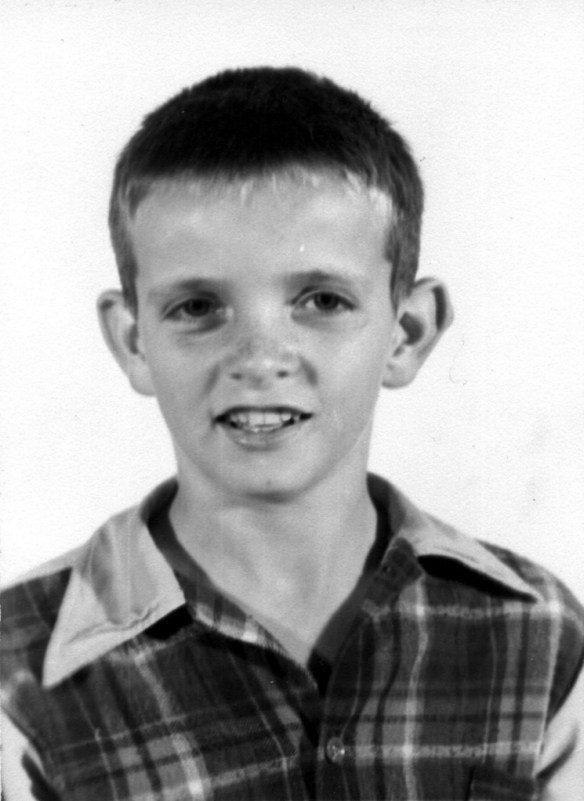
Well, I guess I am beginning a good week! Was lying in bed at 8:30, heard the door-bell, but stayed lying, tho’t it would just go away, but the bell continued ringing and I didn’t feel like getting up, but rather felt like just going on relaxing, then the pounding on the door, calling all the neighbors out to see what was going on, so finally after twenty minutes of such carrying on I got up threw my bathrobe around me and went to the door to see what such carrying ons in my ultra quiet neighborhood meant anyway. So, what do you thing at the door I saw a nice little boy whom his mother and I had called SAMUEL JAY LAPP, and he wondered what it all meant that I didn’t answer the first ring of the door-bell as he always does. You all know this precocious little boy who runs his bycicly into a car, and then refuses to go to see a doctor, but his father quietly takes him.

Ya all know this little boy who used to enjoy eating ground because we didn’t feed him enough dirt at the table, at least so Dr. Paul M always said. You all know this little boy who used to tantalize his little brother and sisters. You all know this little boy who is always concerned about the underdog so much that he takes a bone out of reach of TEDDY and gives it to WINKY, then gets a bite taken out of his own hide as a result.

Ya all know him as the electrician who took a hold of the live wire while standing upon a ladder and wanted to let go but couldn’t so he gave the ladder a kick and fell to the floor that’s how he learned to let go. But he just couldn’t let go of that door bell button. You all know how he likes to drive my car out on the turnpike at 115 miles an hour, and could do this without even getting stopped by a cop and getting a $150.00 fining ticket he is a great guy. But he insisted that I get up early this morning. It was only eight thirty – that’s not even late enough for Grace H to look to see if my curtains are opened or for her to even call the office to tell them they better see what’s wrong with SCHOHN I don’t know now yet why he did it. Why Sara wouldn’t even stand there at the door and try to pound it down, she’d quickly pull out her keys and whalk in, wouldn’t you Sara….

Well that’s chust the way it is in this LAPP CLAN!

Thank you, Grandpa, for this glimpse into how you saw your middle child. You captured his essence. He was indeed nice, precocious, concerned about the underdog, and a risk-taker.

I agree with you, Grandpa. Samuel Jay Lapp was a great guy.

Helen Longenecker’s Dilemma

This Mother’s Day weekend has me returning again to my mother’s journal from college days. The excerpt below is from the start of her second year at Eastern Mennonite College in Harrisonburg, Virginia when she was 22 years old. A few months later she started writing very entertainingly and movingly in the same journal about her emerging relationship with another sophomore, Sam Lapp. Between her journals and many boxes of letters, there is a book about my parents that I hope to write someday (unless I convince one of my daughters to take the project on).

My mother grew up in a loving conservative Mennonite home, in a family that valued education. That’s her on the right of this family portrait from the 50s. After high school she worked for her family’s farm and business near Harrisburg, Pennsylvania for a few years before her dream of going to college came true.

This image has an empty alt attribute; its file name is img_8151.jpg

She was obsessed with literature and one of her concerns about my Dad, as they began dating, was that he wasn’t that into it. She got over that and he gradually became more of a reader and writer himself. I tend to trace the roots of her feminist leanings to their young married years in the mid-60s when they moved to a more liberal Mennonite community in North Newton, Kansas for my Dad to attend Bethel College. But this journal shows that she was frustrated with gender expectations of her day before then.

September 25, 1959

I’m in a dilemma. There is a current idea abroad which needs rethinking. As a girl I am asked to be efficiently intellectual and softly feminine to satisfy the same people. I must get good grades. These grades, however, may not reach the ears of college men, for there is great danger of being shelved as a “brain”. I must not speak too often in classes - it isn't thought quite nice. So the teacher asks an easy question and we girls look decently blank. What kind of Victorian idea is this? Is this a free country? Not really, its girls are tongue-tied. 

I must not offer an opinion of my own on matters, at least not without asking, "What do you think?" (at the risk of having my opinion changed). So I must insult my intellect by stifling any sign of "brilliance" - a word carrying obnoxious associations, it would seem. 

I've tried so far to be versatile, but I wonder how long I continue to "Jekyll" and "Hyde" in this manner. Some girls have no trouble playing this amphibian role, but it takes a conscious, hard effort to keep my "Mr. Hyde" under cover. What if I wake up some morning, an ugly, yellow-clawed, complete intellect?

Mary M, a dear life-long friend of my mother, wrote a letter to my Dad when he was facing terminal cancer, less than a year after my Mom died. The whole letter, including this short excerpt, was such a gift to my Dad and to me and my brothers.

In the pool of available young men of our time and place, I can hardly conceive of anyone who would have been a good husband for Helen. Her openness to people and to other ways of thinking and being, her assertiveness in addressing issues of discrimination and unfairness, would have threatened any man looking for a submissive wife. Sam, you were a wonderful husband to Helen, giving her space to be herself and respecting her. Your marriage was a beautiful example of two people committed in love to each other. In that togetherness you gave a wonderful gift to your nieces and nephews as you affirmed and accepted them, taking long trips to visit them, the Longeneckers being as important to you as the Lapps. 

I am not as assertive as my Mother was. Perhaps this is somewhat in reaction to her personality. Perhaps it’s in part because, thanks to women of her generation and many others before them, I didn’t face the same dilemmas with the same level of intensity. What a gift to be raised by a woman like Helen Longenecker Lapp.

This photo features a painting by my daughter Greta, based on an engagement photo of Helen and Sam. In the foreground is a stone sculpture Sam made as a Bethel College student, where he began forming his identity as an artist. He called this sculpture Madonna. It’s a beautiful image of motherhood that I’m honored to now have in my home along with Greta’s portrait.